Motherhood and the Beast Within
Solo Museum Exhibition
Museum of Ethnography and Contemporary Art Dimitrie N. Ghika
Ghika Palace, Comănești, Romania
2026
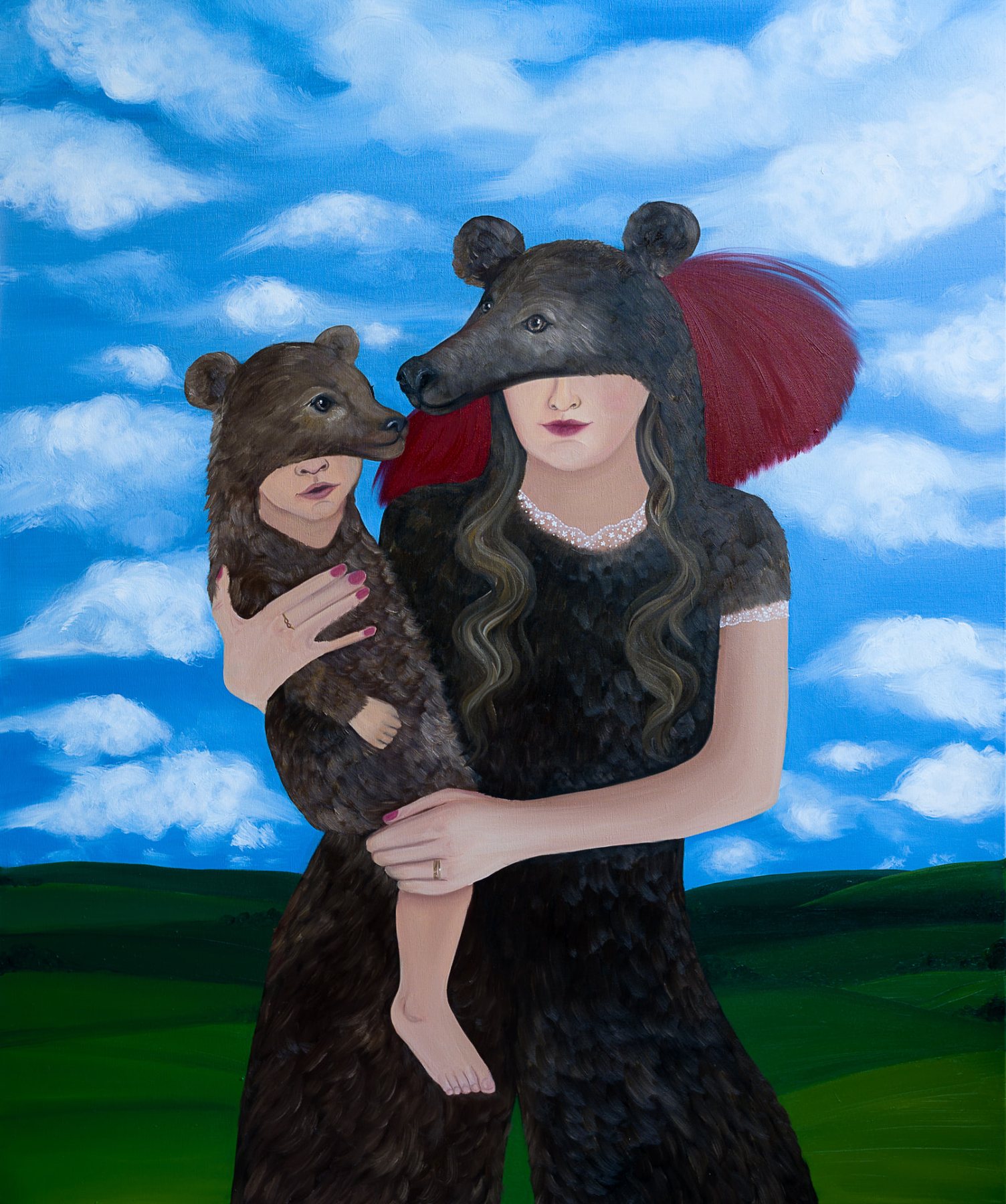
Mama Bear
Elleny Gherghe
2026
oil on canvas
100 x 120 cm
Motherhood and the Beast Within
Available
Iulian Bucur — Art Historian & Art Critic
A title such as Motherhood and the Beast Within can only intrigue. Painter Elleny Gherghe brings together two powerful and seemingly contradictory semantic nuclei. Two instinctive states frame the visual propositions of the exhibition at the Ghika Museum: mother and beast, angel and creature.
For the superficial viewer, these two states might appear to belong to different pages of the great atlas of psychology. Yet, in the painter’s understanding and representation, they share, somewhere in the abyss, the same origin and the same measure; only their meanings diverge.
This is because Elleny speaks about her own motherhood, with all its inherent fears, doubts and uncertainties. For the painter, motherhood is a sum of states — all of them new, none previously experienced, all understood only after they have been intensely lived through and endured.
It is a sum that activates every form of being that a woman possesses, or imagines herself to possess, within her motherhood — both sacred and profane — from living, plasmatic matter to an unstable, evanescent spirit.
Among all these states, one secret form of maternal being is the beast: a state of grace in which the mother focuses her reason and emotions, her energy and determination, on protecting her child from real or imagined dangers.
Most of the compositions are centrally structured. Low horizons divide broad expanses in which vibrant areas meet flatter ones. Something of the academic tradition of mural painting can be found in all the backgrounds.
The eternal theme of motherhood, mother and child, seeks symmetry and balance. The visual impact is immediate; the character is solemn, almost icon-like, reminiscent of Byzantine icons.
The mother-bear’s right hand gently surrounds the body of the bear cub. Beneath the undefined, brown bestial profiles, the lighter enamel of the anthropomorphic forms emerges — carefully articulated portraits and self-portraits.
Through these self-portraits, the entire spectrum of emotions experienced by a mother beside her child unfolds almost cinematographically.
Particularly moving is the mother breastfeeding her child high in a tree, perhaps in the Tree of Life, above the world, from which only flames of light remain.
The painter is attentive to details, transforming them into symbolic anchors. They construct the message of the exhibition. Open palms, wide eyes, clear foreheads, bear claws, the breasts of the martyr Olalla, symmetrical drops of breast milk, drops of blood and everlasting flowers all testify to the many questions a mother asks without finding an answer.
And these same terrible details speak of the many questions that wound a mother, questions for which she has neither the time nor the strength to find an answer.
Because she is herself — and he is her child.
In the Trotuș Valley, the wildness of the bear carries a meaning unlike anywhere else in the world. The totemic animal presides over the impenetrable forests through strength, courage and, perhaps, inner stillness.
The Ghika family of Comănești was known for the royal bear hunts they organized. And there is probably no descendant of the beaters who once guarded this frontier who has not, at least once, worn a bear skin, like the White Moor in Creangă’s tale.
Today, the image of the bear-man performing during the New Year celebrations appears in major photography magazines.
On Dragobete, the mother bear brings her cubs out of the snow. The cubs are small, almost blind and completely dependent on their mother, who is weakened and hungry, yet determined to survive.
She feeds them with her warm milk and endures their bites. She warms them with her body, and the cubs trust her. She protects them and teaches them how to climb the trees of the forest and how to hunt.
And they will love her. They will love her even after that day — the day that inevitably comes, when the forest, like every wild forest, will separate them.
Curatorial text — Art historian and art critic Iulian Bucur